

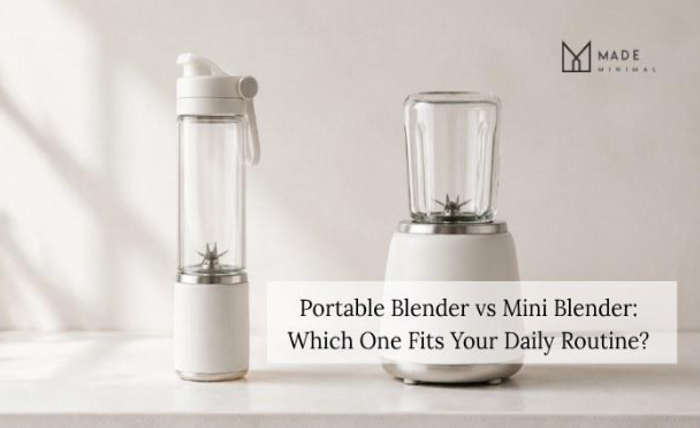
Right off the bat, a portable blender and a mini blender look like they do the same job. But when it comes down to daily use, one of them will suit your routine far better than the other. Picking the wrong one means a blender that collects dust on your bench.
Okay, so here’s the deal. The main difference lies in portability and power. They also differ in capacity, blending style, and cleanup. A few more details can help you decide, and Made Minimal breaks those down here.
After reading this article, you’ll know exactly which blender suits you and why. The sooner you decide, the quicker every morning gets a little smoother.
Portable Blender vs Mini Blender: What’s the Real Difference?
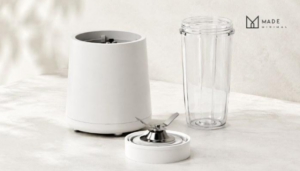
The prime difference between a portable and mini blender isn’t dependent on one factor alone. You might be thinking they’re basically the same machine, but they really aren’t. They differ in power source, capacity, motor strength, and how you use them daily.
For instance, a portable blender runs on a rechargeable battery. That means you can blend anywhere without needing a power point nearby. A mini blender, on the other hand, plugs directly into the wall and stays in your kitchen.
The design philosophy behind each one is different too. A portable blender is built for the convenience of transporting as the utmost priority. But a mini blender is built for consistent power and better blending results at home.
One area where this difference significantly shows up is how each blender handles frozen fruit and ice. We’ll get into that next.
Crushing Ice and Frozen Fruit: Which Blender Handles It Better?
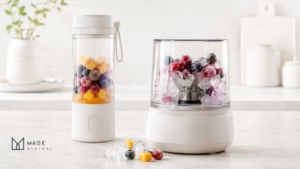
Portable blenders struggle with hard ice but handle soft frozen fruit reasonably well. But mini blenders, in general, perform better with frozen ingredients across the board.
Now here’s where it gets tricky. Most people assume any blender handles ice well, until their motor gives out mid-blend.
The reality is, ice and frozen fruit aren’t forgiving on a weak machine. They demand sharp blades, a strong motor, and the right blending technique, like pulse blending, layered loading, and liquid-first blending.
Let’s break down how each one performs.
How a Portable Blender Handles Frozen Ingredients
Portable blenders can handle frozen fruit, but only if the pieces are small enough. Think about tossing a handful of frozen mango into one. You’ll need smaller pieces and a bit more patience to get a smooth result.
Here’s how to get the best out of it:
- Pre-cut frozen fruit into small, bite-sized pieces first.
- Add a splash of liquid before blending to help it along.
- Blend in short pulses rather than one long continuous run.
- Avoid dropping whole ice cubes in (if anyone has this evil intention) as they’ll stall the blade fast.
That works well enough for soft frozen fruit. But when it comes to crushing ice properly, a mini blender is a different story altogether.
What a Mini Blender Does Differently With Ice
A mini blender gives you consistently smoother results with far less effort on frozen ingredients. The motor typically runs at 200 to 600 watts, so crushing ice isn’t the struggle it is with a portable model.
The wider jar base also gives the blades more contact with frozen ingredients from the start. So if you’re blending ice or hard frozen fruit on a regular basis, the mini blender is the more reliable pick.
Personal Blender Performance: Motor Power and Blade Quality
Motor wattage and blade design are the two things that separate a good personal blender from a frustrating one. A low-wattage motor will stall on tough ingredients like frozen fruit, vegetables, or protein powder. That’s when blending becomes more of a chore than a quick daily task.
Blade design plays an equally important role, though. More blades don’t always mean a smoother result. What counts is the blade angle, sharpness, and how well it moves ingredients toward the cutting edge.
Based on our firsthand experience, the best personal blenders handle everything from smoothies and shakes to soups and sauces without breaking a sweat. A powerful motor and a well-angled blade work together to give you that smooth finish every single time.
Daily Routine Fit: Which One Actually Works for Your Lifestyle?
Most people pick a blender based on looks. The one that fits your daily habits is the one worth buying. Your routine, kitchen space, and blending frequency all determine which option works best for you down the track.
Below, we’ll show you which blender fits three of the most common daily routines.
If You’re A Commuter or Office Worker
A portable blender is lightweight and charges via USB overnight. It slips into your bag without taking up much room, so your morning smoothie is ready before you even leave the house. That alone makes it a genuinely convenient pick for anyone rushing out the door each morning.
On top of that, most portable blenders come with a detachable cup built right in. So you blend directly in the cup, snap the lid on, and carry your drink straight to the office. No extra containers or messy cleanup before work.
For the Home Kitchen User
Blending at home daily means you need consistent power, and a mini blender delivers that every time. It sits on your kitchen counter, plugs straight in, and is ready to run without any charging wait. For anyone who blends every morning at home, that reliability is hard to beat.
It also handles a wider variety of ingredients compared to a portable model. Fresh fruits, vegetables, juice, milk, and soups all blend smoothly and evenly. That said, if your blending needs to go beyond a basic smoothie, a mini blender is the more capable pick for your kitchen.
Best Solution For Gym-Goer or Traveller
Post-workout nutrition stays on track no matter which city, gym, or hotel room you’re in. A portable blender is compact enough for your gym bag, carry-on luggage, or a hotel room bench. That kind of flexibility is something a bulky kitchen blender simply can’t offer.
In terms of what it handles, you can add your protein powder, some frozen fruit, and a cup of water, and your shake is done in under a minute. It’s lightweight, rechargeable, and built for people whose routines rarely look the same two days in a row.
Verdict: Neither blender is universally better. It really depends on how your days run.
Smoothie Blender Showdown: Capacity, Cleanup, and Convenience
Two things most people overlook here are capacity and cleanup. They aren’t the flashiest things to think about, but they’re what you’ll notice most after the first week of daily use.
Here’s a quick side-by-side look at how both blenders compare.
| Feature | Portable Blender | Mini Blender |
| Capacity | 300–400ml | 600–1,000ml |
| Power Source | Rechargeable battery | Power outlet |
| Cleanup | Rinse cup directly | Remove jar, rinse separately |
| Lid | Durable, easy-to-use lid | Standard blender lid |
| Portability | Fits in a bag | Stays in the kitchen |
| Best For | Smoothies, shakes, drinks | Smoothies, soups, juices, milkshakes |
Both blenders are reasonably quick to clean. A portable blender just needs a rinse under the tap after use, which takes under a minute. But a mini blender requires removing the jar and rinsing each part separately. However, it’s not a big deal for home kitchen users since the whole process takes under two minutes.
The final decision looks like this: a portable blender wins on portability, while a mini blender wins on capacity. The right one depends on where and how often you blend.
How Long Do Portable and Mini Blenders Actually Last?
A portable blender, given its compact build and battery-powered motor, typically lasts two to four years with regular daily use. The battery is usually the first thing to wear down over time.
A mini blender, on the other hand, tends to last longer. Most reliable models run well for five to eight years with proper care. The motor is more powerful and doesn’t rely on a rechargeable battery, so there’s one less component to wear out.
That said, how long either blender lasts comes down to the brand you pick and how well you look after it. Regular cleaning, avoiding overloading the motor, and storing it properly all add years to its life.
So, Which One’s Coming Home With You?
Both blenders have real strengths, and neither one is a bad pick. The safe bet is to go with the one that genuinely fits how your days run. A portable blender is built for people on the move. Meanwhile, a mini blender is built for consistent power at home.
Makes sense, right? The better pick depends on where you blend, what you blend, and how often you do it. Those three things will point you in the right direction every time.